
What Are Filler Words? Definition, List of Filler Words, and How to Stop
What are filler words? Sounds and phrases like um, uh, like, and you know that fill pauses without adding meaning. Full list of filler words with examples, why we use them, and how to cut them.


What are filler words? They're sounds, words, and short phrases like "um," "uh," "like," "you know," and "basically" that speakers use to fill a pause or hold the floor while they think, without adding meaning to the sentence. Linguists usually split them into two groups: filled pauses (the hesitation sounds "um" and "uh") and discourse markers (words like "like," "you know," "so," and "I mean" that manage the flow of a conversation).
Everyone uses them. The question is how many, and where. In a live conversation, a few "ums" are normal and can even help the listener. In a recorded video, podcast, or presentation, they pile up fast and make you sound less prepared than you are.
This guide explains what filler words are, why people use them, a full list of filler words with examples, when they're fine, and how to use fewer of them.
Disclosure: We make BlitzCut, a Mac, iPhone, iPad, and Android video editor that removes silences and lets you cut filler words by editing the transcript. The research cited below is from independent linguists and psychologists.
What are filler words, exactly?
A filler word is anything you say that keeps sound coming out of your mouth while your brain catches up. Remove it, and the sentence still means the same thing:
- "So, um, the launch is on Friday." → "The launch is on Friday."
- "It's, like, basically done, you know?" → "It's done."
Filler words go by several names. You'll see them called:
- Filled pauses or hesitation markers: "um," "uh," "er," "ah"
- Discourse markers or discourse particles: "like," "you know," "I mean," "so," "well," "right"
- Speech disfluencies: the broader category that also includes restarts, repeated words, and stutters
- Verbal crutches or verbal tics: the public-speaking terms for a filler you lean on constantly
The distinction matters because the two main groups behave differently. In a study of everyday recorded speech, Laserna, Seih, and Pennebaker (2014) found that "uh" and "um" became less common with age but weren't linked to gender or personality, while discourse markers ("I mean," "you know," "like") were used more by younger people and, surprisingly, by more conscientious people.
Why do we use filler words?
Filler words aren't a sign that someone is unintelligent. They show up because speaking in real time is hard: you plan the next sentence while still saying the current one.
They signal a delay. Psychologists Herbert Clark and Jean Fox Tree argued in a 2002 paper in Cognition that "uh" and "um" are real English words that speakers choose on purpose. In their account, "uh" announces a short delay and "um" a longer one. Other researchers have questioned parts of their method, but the idea that fillers carry a signal ("hold on, I'm still talking") is widely accepted.
They hold your turn. In conversation, silence invites the other person to jump in. A filler tells them you haven't finished.
They soften what you say. "I mean," "kind of," and "like" make a statement less blunt, which is why they're so common in casual talk.
They're habits. Many fillers are just verbal tics. Someone who says "basically" or "literally" every sentence usually doesn't notice until they hear a recording.
They change over time. Across English, German, Dutch, and other Germanic languages, Wieling and colleagues (2016) found that "um" is gradually replacing "uh," and that women and younger speakers are leading the change. Language Log's analysis of German speech shows the same pattern: the share of "um" rises sharply in speakers born more recently.
List of filler words (with examples)
Here's a categorized list of filler words in English, with an example of each and when it's actually fine to use.
| Category | Filler words | Example | When it's fine |
|---|---|---|---|
| Hesitation sounds (filled pauses) | um, uh, er, erm, ah, hmm, eh | "We should, um, move it to Friday." | Live conversation and Q&A, where a short "um" sounds natural |
| Discourse markers | like, you know, I mean, so, well, right, okay, anyway, now | "So, like, we tried it and you know, it worked." | "So" or "now" to open a new section, "well" before a considered answer |
| Hedges and softeners | kind of, sort of, I guess, I think, maybe, a little bit, just, pretty much | "It's kind of just a small fix." | When you really are uncertain or need to be polite |
| Empty intensifiers | basically, literally, actually, honestly, totally, really, seriously, definitely | "I literally basically finished it." | When the word means what it says ("Actually, the data shows the opposite.") |
| Tag questions and check-ins | right?, you know what I mean?, okay?, does that make sense?, yeah? | "It's the second button, right?" | When you're genuinely checking that someone followed you |
| Stock phrases | at the end of the day, to be honest, the thing is, if that makes sense, believe me, needless to say | "At the end of the day, it's about the customer." | Rarely. Most add length without meaning |
| Trailing fillers | and stuff, or whatever, or something, and everything, and all that | "We updated the pricing and stuff." | Casual chat with friends |
| Restarts and repeats (disfluencies) | "I, I, I," "we should, what I mean is," "the, the" | "We, we should, what I mean is, cut it." | Never needed on a recording. These are the first thing to edit out |
Quick list of common filler words
If you just need the words, here are the most common English filler words in one place:
um, uh, er, erm, ah, hmm, like, you know, I mean, so, well, right, okay, anyway, basically, literally, actually, honestly, totally, really, seriously, just, kind of, sort of, I guess, I think, pretty much, you see, at the end of the day, to be honest, the thing is, if that makes sense, and stuff, or whatever, or something, you know what I mean, does that make sense
Not every use of these words is filler. "I like this design" isn't a filler; "this design is, like, good" is. The test is simple: if you delete the word and the sentence means the same thing, it was filler.
Filler words in other languages
Every language has its own fillers. A few you'll hear often:
| Language | Common filler words |
|---|---|
| Spanish | este, eh, o sea, pues, bueno, ¿sabes? |
| French | euh, ben, bah, genre, tu vois |
| German | äh, ähm, also, halt, ne? |
| Dutch | eh, ehm, nou, dus |
| Japanese | eto, ano, maa |
If you're a non-native speaker, your fillers may carry over from your first language. That's normal, and a transcript makes it easy to spot.
Are filler words bad?
Not always. The research is more mixed than most public-speaking advice suggests.
They can help listeners. In an experiment at the University of Illinois, Scott Fraundorf and Duane Watson played people a story in three versions: fluent, with "uh" and "um" added, and with coughs added in the same places. Listeners remembered the version with fillers better. Watson's explanation was that fillers may make listeners pay closer attention. A later partial replication found mixed results, so it's not a reason to add fillers on purpose.
Too many hurt. A Queen Margaret University study that used a similar method found that excessive disfluencies, combined with fast speech, made it harder for listeners to recall what they heard.
They shape how knowledgeable you seem. Listeners use fluency as a cue to how sure a speaker is. Psychologists call this the "feeling of another's knowing," and research reviewed at the University of Edinburgh found listeners make fairly reliable judgments about a speaker's knowledge from hesitations. That's useful in conversation, but on a sales video or course lesson, frequent "ums" can read as uncertainty even when you know the material.
The practical rule: an occasional filler in live speech is fine. A filler every sentence, or any filler in a recording you could have edited, is worth fixing.
Filler words in presentations, interviews, podcasts, and video
Where you're speaking changes how much fillers matter.
Presentations and public speaking
On stage, fillers are most noticeable at the start of sentences and between slides ("So, um, next slide..."). Toastmasters clubs even assign an Ah-Counter, a member who tracks every speaker's filler sounds and crutch words and reports them at the end of the meeting. A planned transition sentence for each slide removes most of them.
Job interviews
Fillers spike when you're asked a question you didn't expect. A short silent pause before answering ("That's a good question.") sounds more confident than "Um, so, like, I guess...". Fillers are more forgivable here than on a recording, because interviewers expect you to think on your feet.
Podcasts
Long conversations produce a lot of fillers, and listeners notice them more on audio because there's nothing to look at. Most podcast editors remove the worst clusters and leave a few so the conversation still sounds natural.
YouTube, TikTok, Reels, and Shorts
On short-form video, every second counts. A "so, um, hey guys" opening wastes the first second, which is the part that decides whether people keep watching. For talking-head videos, cutting fillers and dead air is usually the single biggest improvement you can make. See how to write a hook for talking-head videos for the opening itself.
Filler words in writing
Writing has fillers too: "just," "really," "very," "actually," "basically," "in order to," and "that" when it isn't needed. They're easier to fix because you can delete them before anyone reads them. Read your draft and cut any word that doesn't change the meaning.
How to stop using filler words
You won't get to zero, and you don't need to. These drills cut the habit down quickly.
- Record yourself and count. Talk for two minutes about your day or your work, then play it back and tally every filler. That's your baseline. Repeat weekly. Most people find one or two "favorite" fillers make up most of the count.
- Replace the filler with a pause. When you feel an "um" coming, close your mouth and pause instead. A one-second silence sounds deliberate to a listener, even though it feels long to you.
- Slow down. Fillers appear when your mouth gets ahead of your thinking. Speaking a little slower gives your brain time to find the next word.
- End sentences cleanly. Many fillers come from chaining sentences with "and, um, so, and." Finish the sentence, drop your pitch, and stop. Then start the next one.
- Script the first and last line. Openings and closings are where fillers cluster. Know your first sentence word for word, and your last.
- Use bullet points, not a full script. Reading a full script often sounds stiff, while having no notes produces fillers. Three to five bullets is the middle ground. If you do read, a teleprompter keeps your eyes on the lens.
- Practice transitions. Write out the sentence that moves you from one point to the next. Transitions are where "so, um, anyway" lives.
- Get feedback. Ask a friend to tap the table every time you use a filler, the way a Toastmasters Ah-Counter does. It's annoying, and it works.
How editors remove filler words from recordings
If the video is already recorded, you don't have to re-record it. There are two ways to remove filler words:
- Timeline editing: listen through the whole recording, split the clip at every filler, delete the piece, and close the gap. It's precise but slow, because you have to watch everything at normal speed.
- Transcript editing: the editor transcribes the video, and you delete fillers as text. The matching video is cut for you. This is much faster on long recordings, because you scan text instead of listening.
We've covered both methods step by step in how to remove filler words from video, and compared the tools in removing filler words on Mac: Descript vs Gling and others.
Removing filler words in BlitzCut
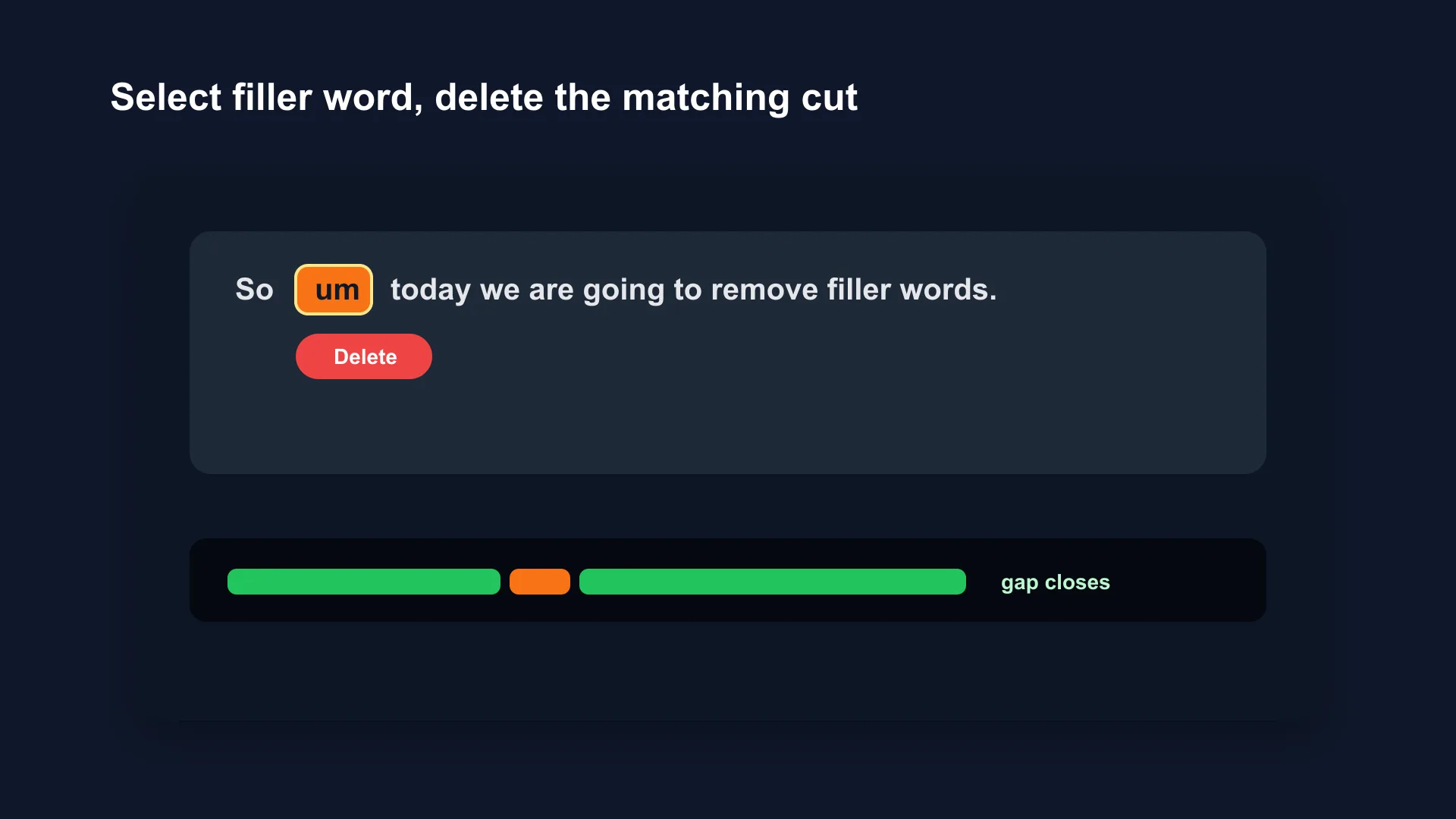
BlitzCut is built for videos of people talking. You import the recording, it transcribes the speech, and you clean it up by editing text:
- Delete fillers as text. Select an "um" or a "you know" in the transcript and delete it. The video cut happens automatically.
- Remove false starts in one selection. Select a whole restarted sentence and delete it.
- Close the gaps. Automatic silence removal tightens the pauses left behind, so the edit doesn't sound choppy.
- Add captions after. Word-by-word captions are generated from the same transcript, so they match the cleaned-up audio.
It's not a full video suite. If you need color grading or complex multi-track edits, you'll still want a timeline editor. But for talking-head videos, podcasts, and lessons, editing out fillers in the transcript takes minutes instead of an evening of scrubbing. See the filler word remover page for how it works, or text-based editing for the editing model behind it.
Frequently Asked Questions
What are filler words called?
Linguists call "um" and "uh" filled pauses or hesitation markers, and words like "like," "you know," and "I mean" discourse markers. Together they fall under speech disfluencies. In public speaking, they're often called verbal crutches or verbal tics.
What are some examples of filler words?
Common examples are um, uh, er, like, you know, I mean, so, well, right, okay, basically, literally, actually, honestly, kind of, sort of, and phrases like "at the end of the day" and "to be honest." See the list of filler words above for more.
Why do people say "um" so much?
Speaking in real time means planning the next sentence while saying the current one. "Um" fills the gap and signals that you haven't finished talking. Clark and Fox Tree argued that "um" specifically announces a longer delay than "uh."
Is "like" a filler word?
Sometimes. "I like coffee" uses it as a verb, and "it looks like rain" uses it as a preposition. It's a filler when you can remove it without changing the meaning: "It was, like, really hard."
Are filler words bad?
Not in small amounts. Research suggests occasional "uhs" and "ums" can help listeners pay attention, and they make live conversation feel natural. Too many, especially in recorded video or presentations, make speech harder to follow and can make you seem less certain.
How do I stop saying "um"?
Record yourself, count your fillers, and replace them with silent pauses. Slow down, finish each sentence cleanly, and script your first line and your transitions. For recordings, you can also cut them afterwards in the transcript.
Do filler words count in writing?
Yes. In writing, "just," "really," "very," "actually," "basically," and "in order to" are common fillers. Deleting them usually makes a sentence clearer.
Related: How to Remove Filler Words from Video · Remove Filler Words on Mac: Descript vs Gling · How to Write a Hook for Talking-Head Videos · How to Use a Teleprompter · Filler Word Remover
Editing a talking-head video?
BlitzCut is available on Android, iPhone, iPad, and Mac. It is designed for recorded UGC-style videos, founder-led ads, tutorials, and testimonials and other talking-head content.
Try it for freeRelated Articles
Keep Reading

Best Lavalier Mic for iPhone (2026): Wireless and Wired Picks for TikTok and Reels
The best lavalier mic for iPhone: DJI Mic Mini for most creators, RØDE Wireless Micro for two people, DJI Mic 3 for backup recording, and a wired lav under $30. Compared for TikTok, Reels, and Shorts.

Best Mac App to Remove Silence From Video (2026): 9 Tools Compared
The best Mac apps to remove silence from video: BlitzCut for talking-head videos with captions, Recut or TimeBolt before Final Cut or Premiere, Premiere's pause filter, Descript, Gling, and free auto-editor.

Best Ring Light for TikTok and Content Creators (2026)
The best ring light for TikTok and content creators: an 18-inch kit for most talking-head videos, plus 10-, 14-, and 21-inch picks compared by brightness, portability, and price.