
How to Write a Hook for Talking Head Videos (With Examples)
How to write a hook for talking head video — verbal delivery, visual first frames, hook formulas, and platform differences for YouTube, TikTok, and Reels.


A talking head video hook is different from any other format because the creator is the visual and the audio simultaneously. There's no b-roll to carry the first frame, no graphic to display before you speak, no product or scene to show. The hook is your face, your first word, and whatever you have on screen. That creates a constraint and an opportunity: your delivery, energy, and first sentence carry everything.
This guide covers how to write and deliver a talking head hook that holds viewers through the first 3 seconds — and how to prepare the shot itself so the first frame works before you speak a word.
What Makes Talking Head Hooks Unique
Most hook guides focus on what to say. Talking head video requires equal attention to how you appear when you say it, because on-camera delivery determines whether the written hook actually lands.
A strong hook written for a talking head video has three simultaneous layers:
| Layer | What it is | Why it matters |
|---|---|---|
| Written hook | The first sentence you speak | The content of your argument for why the viewer should stay |
| Delivery | Energy, pace, eye contact | Whether the written hook is convincing as delivered |
| First frame | What the viewer sees before audio registers | Catches muted viewers; signals energy to all viewers |
All three can be independently executed well or poorly. The best talking head hooks execute all three simultaneously.
Layer 1: The Written Hook
The written hook is your first spoken sentence. For talking head video across platforms in 2026, the research is consistent: hooks under 2 seconds (roughly 10–15 words) have significantly higher retention than longer setups.
A 2025 analysis of 10,000 viral short-form videos by Later found that hooks under 2 seconds had a 23% higher completion rate than hooks stretching to 4–5 seconds.
The Core Formula
[Specific claim or question] + [why the viewer should care]
Both parts can be compressed into one sentence. The viewer doesn't need your name, your channel, or context about who you are in the first sentence. They need to know why the next 30–60 seconds is worth their time.
Strong written hooks for talking head:
- "The one edit that doubled my video views — and it's not what you'd guess."
- "If your videos aren't growing, it's almost never the content. It's this."
- "I wasted 8 months editing the wrong way. Here's what changed."
- "Most creators think posting more is the answer. The data says otherwise."
Weak written hooks for talking head:
- "Hey everyone, welcome back to my channel. So today I wanted to talk about..."
- "In this video, I'm going to be showing you how to..."
- "This is going to be a really interesting one, so make sure you stay to the end."
The weak examples share a common flaw: they announce the content before delivering it. Announcement language delays value and signals low energy.
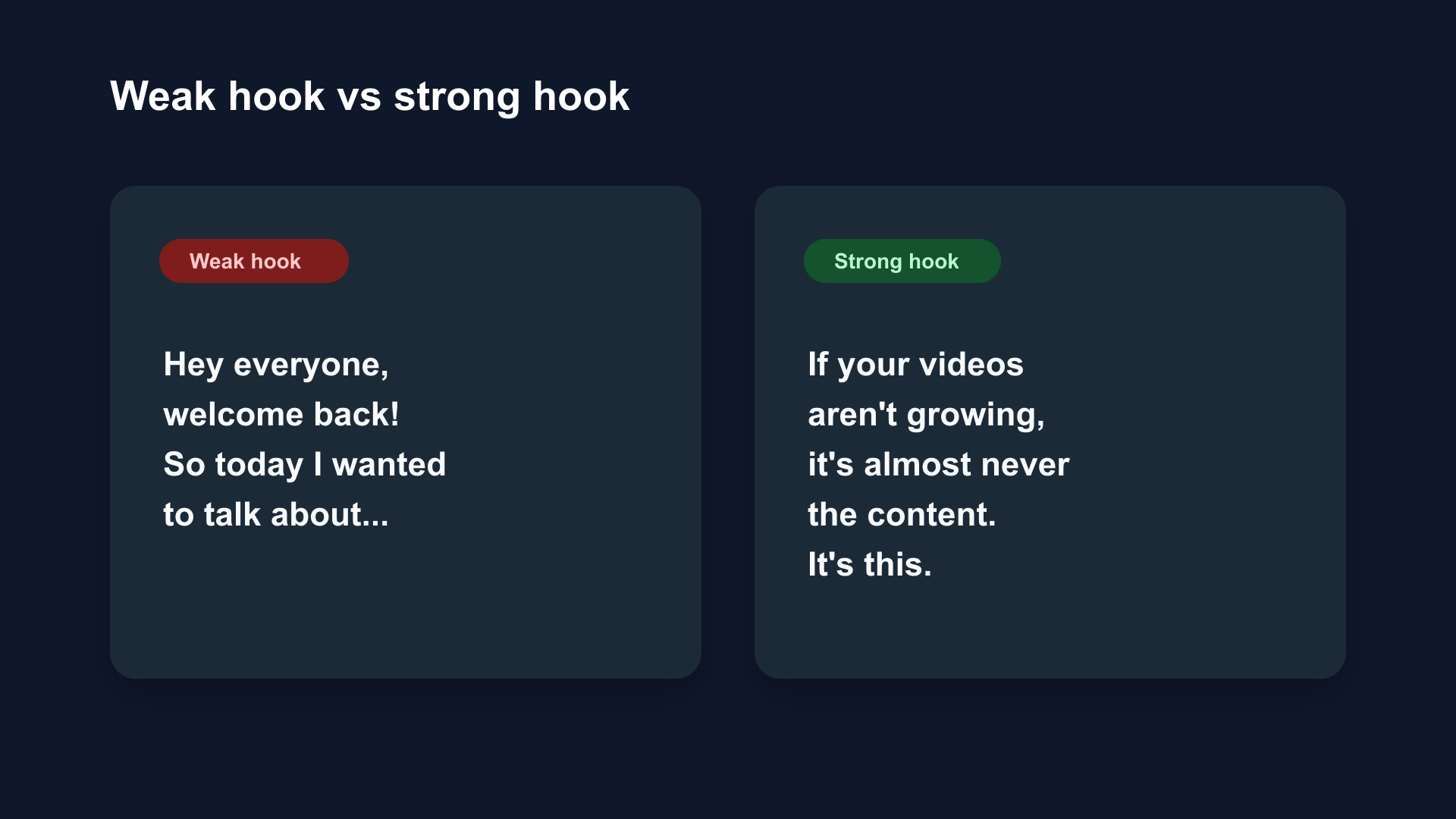
Two ways to open the same talking head video. The strong hook delivers value in the first sentence. The weak hook announces it's coming.
Layer 2: Delivery
The same words, delivered differently, produce dramatically different results. This is the layer that separates written hook guides from talking head video guides specifically.
Look at the Lens, Not the Screen
In a talking head video, eye contact with the viewer is made by looking at the camera lens — not the screen where you see yourself. Most creators naturally look at their own face on screen, which produces a slightly downward or sideways gaze that reads as disengagement to the viewer.
Mark the lens with a small sticker or ring the perimeter with tape during practice sessions until lens-looking becomes automatic. The first frame of a talking head video where the creator is already making direct eye contact creates an immediate connection signal that holds viewers past the hook.
Start Speaking Before You "Feel Ready"
The most common talking head hook mistake is the unconscious pause before the first word — the moment where you breathe in, gather yourself, and then begin. That pause is 0.5–1 second of dead air at the very beginning of the video.
Research from TikTok's creator toolkit shows that dead air in the first 2 seconds substantially increases swipe probability. A viewer who encounters silence or low-energy setup in frame 1 is already deciding whether to swipe before your hook lands.
Fix: Record yourself starting mid-sentence — speak the hook before you expect to be "ready." The first take that feels too fast is often the right take. You can trim any dead start in editing, but you can't fix a slow hook after the fact.
Match Energy to Content
Talking head hooks that work have energy calibrated to the claim being made. If you're saying "I cut my editing time from 4 hours to 20 minutes" — say it like you mean it. Not loudly, but with the genuine energy of someone who actually did that.
Flat, even-toned delivery of a bold claim makes the claim feel unbelievable. The delivery confirms or undermines the written hook. A bold hook delivered flatly produces the same result as a weak hook.
Layer 3: The First Frame
For talking head video, the first frame is the creator's face and upper body on a background. There's no hiding behind b-roll. Optimizing the first frame means optimizing the shot.
What the First Frame Should Contain
The creator already in motion. Don't start the video with a static shot of yourself getting ready to speak. Begin the recording mid-sentence — even if you cut the actual first frame to a few words in, the energy from already being mid-speech carries into the first visible frame.
Direct camera gaze. As covered in the delivery section — lens contact from frame 1.
A clean, intentional background. A distracting background competes with your face for the viewer's attention in the first frame. Clean backgrounds (neutral wall, tidy bookshelf, simple setup) direct attention to you.
Good front lighting. Dim or overhead-lit first frames read as low-production. Even a basic ring light or window facing you dramatically improves how authoritative the first frame looks. Viewers make instant quality judgments from lighting before processing any content.
Bold text overlay (optional but recommended). A 5–8 word text overlay on screen that states the hook in written form catches muted viewers from the first frame. It also reinforces the verbal hook for audio-on viewers.
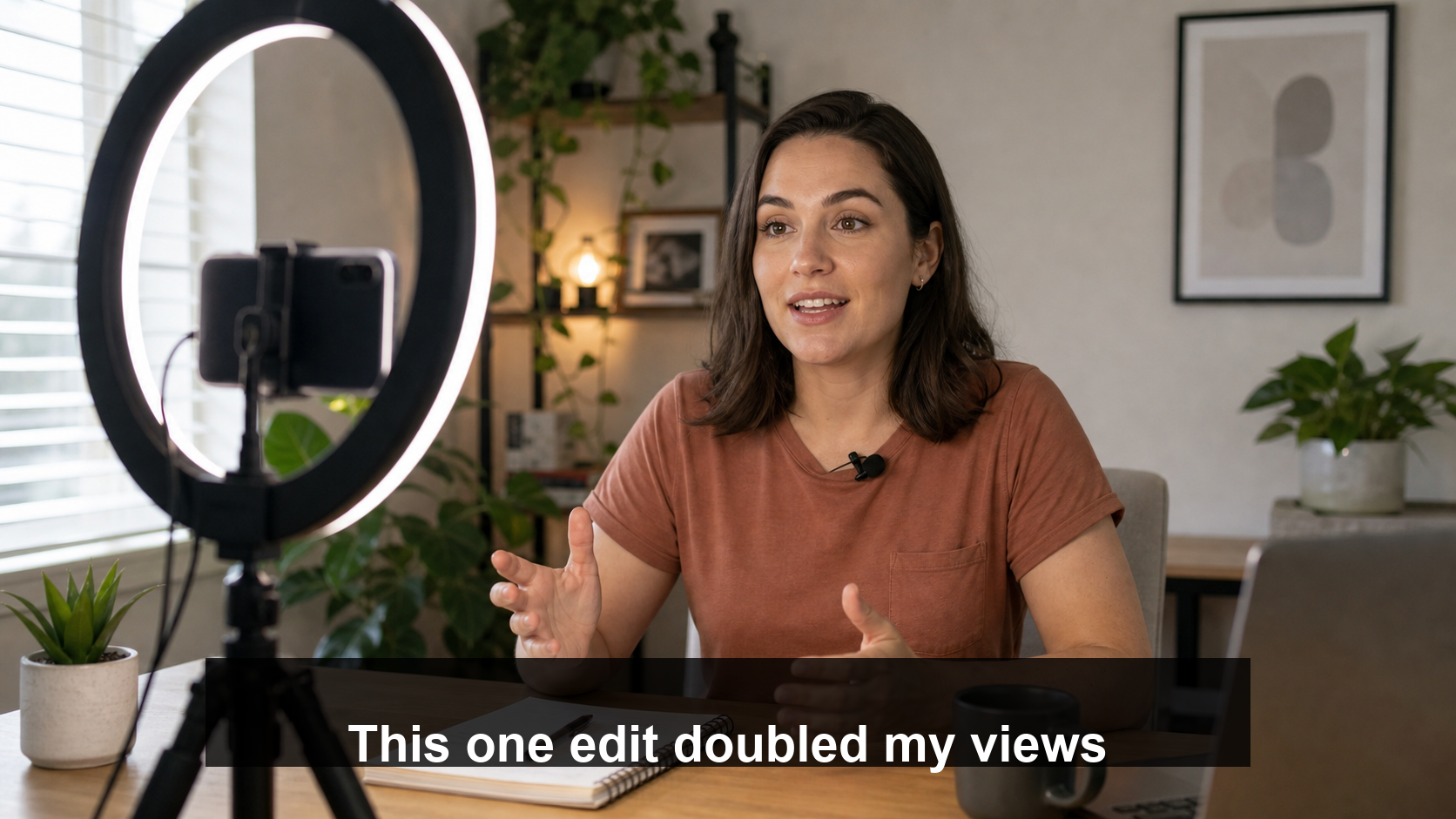
A strong talking head first frame: front-facing light, clean background, creator already in motion, bold text overlay stating the hook. Each element is doing work.
6 Hook Formulas for Talking Head Video
These formulas work across YouTube long-form, YouTube Shorts, TikTok, Instagram Reels, and LinkedIn Video. They're format-specific (talking head delivery), not platform-specific.
Formula 1: The Result-First
State your most compelling result immediately. No buildup.
Structure: "[Specific measurable result] — here's how."
Examples:
- "My last video hit 200K views with 800 subscribers. Here's the exact hook I used."
- "I edited a 10-minute video in 22 minutes flat. This is the workflow."
- "I went from 4 hours of editing per video to 25 minutes. Let me show you what changed."
Why it works for talking head: Result-first hooks give the creator immediate credibility in the first frame. You're not claiming authority — you're demonstrating it.
Formula 2: The Specific Problem
Name a specific problem your viewer has. The more precise the problem description, the more the viewer feels like the video was made for them.
Structure: "If you [specific problem], here's what's actually going on."
Examples:
- "If your videos are getting views but no followers, here's the real reason."
- "If you keep starting videos that never get finished — this is why."
- "If you've been posting consistently with no growth, stop everything. Watch this first."
Why it works for talking head: Problem-specific hooks work particularly well when delivered with genuine recognition energy — the sense that you've experienced the problem yourself. Talking head video is the format where that authenticity is most visible and most credible.
Formula 3: The Counterintuitive Claim
State something that contradicts what your viewer probably believes.
Structure: "[Common belief] is actually [opposite or complication]. Here's the data."
Examples:
- "Posting more content doesn't help Shorts grow. This does."
- "Your hook isn't what's killing your retention. It's the 10 seconds after it."
- "The most engaging talking head videos aren't the most polished ones. Here's why."
Why it works for talking head: Counterintuitive claims delivered on camera feel more credible than in text. The viewer can read your face for confidence in the claim — a well-delivered contradiction lands with more authority than the same words in a blog post.
Formula 4: The Question That Demands Resolution
Ask a question that the viewer genuinely wants answered and can't answer without watching.
Structure: "Why does [specific thing] actually [surprising behavior]?"
Examples:
- "Why do creators with worse production quality often grow faster?"
- "Why does removing silence from your videos increase watch time by more than captions do?"
- "Why do some talking head videos feel fascinating and others feel like a lecture?"
Why it works for talking head: On-camera question delivery creates a conversational expectation — the viewer is now in a mental dialogue with you. That state of engagement keeps them through the answer.
Formula 5: The Confession or Mistake
Start with a mistake you made — specific, real, slightly embarrassing.
Structure: "I [specific mistake] for [timeframe]. I wish someone had told me [thing]."
Examples:
- "I spent 18 months saying 'um' every 8 seconds and wondering why no one shared my videos."
- "I used to start every video with a 20-second intro. My retention was 18%. I deleted it and hit 67%."
- "I thought more equipment would fix my videos. It wasn't the equipment."
Why it works for talking head: Confessions are inherently watchable because they require vulnerability — and vulnerability on camera is rare enough to hold attention. A creator who openly admits a mistake on camera earns more trust than one who positions themselves as an authority from the first frame.
Formula 6: The "This One Thing" Hook
Frame the entire video as a single specific insight or change.
Structure: "There's one [thing/mistake/tool/habit] that [dramatic result]. Here it is."
Examples:
- "There's one editing mistake that's costing you 60% of your viewers. Here it is."
- "There's one thing every fast-growing talking head creator does in their first 3 seconds."
- "One change to how you open your videos will double your retention. I tested it."
Why it works for talking head: The "one thing" frame is maximally specific. Viewers know exactly what they're getting and exactly how long it will take. For talking head video — where the creator must sustain visual engagement without b-roll — specificity is a structural advantage.
The Role of Editing in Hook Performance
A strong hook can still fail if the editing introduces problems in the first 3 seconds.
Dead air before the first word. Any gap between the start of the video and the first word increases swipe probability. Most recording software captures a moment of silence before you begin speaking — this needs to be removed in editing.
Unstable audio at the start. If your first word is quieter than the rest (common when you start speaking before reaching optimal microphone distance), it reads as low-quality. Normalize audio levels in your editor before exporting.
Cut into the hook. Don't start the video with the camera already rolling for several seconds before you speak. Cut the start to within 0.1–0.2 seconds of your first word. The viewer should get straight to you, already speaking.
BlitzCut handles silence removal on-device immediately after import — including any dead air at the very beginning of the recording. The transcript view shows exactly where the first word falls, so you can confirm the video starts clean. Mac and iPhone, under $6/month billed annually.
Platform Differences for Talking Head Hooks
The same talking head hook formula works across platforms, but the emphasis shifts:
| Platform | Primary quality signal | Hook emphasis |
|---|---|---|
| YouTube Shorts | Swipe-away rate (first 2 sec) | Speed — land the hook before 2 seconds |
| Instagram Reels | DM shares | Relatability — make it shareable to a specific person |
| TikTok | Completion rate + shares | Curiosity gap — make them need to see how it ends |
| YouTube long-form | Click-through + watch time | Promise — state exactly what the viewer will learn |
| LinkedIn Video | Views + engagement | Professional stakes — why this matters for their career/business |
The written formula doesn't change. The delivery and emphasis do.
Frequently Asked Questions
How long should the hook be in a talking head video?
One sentence, under 2 seconds. That's roughly 10–15 words spoken at a natural-but-slightly-fast pace. Research consistently shows that hooks under 2 seconds outperform longer setups for viewer retention, across YouTube, TikTok, and Instagram Reels.
Should I write my hook in advance or improvise it?
Write it. Improvised hooks tend to ramble — adding context, qualifiers, and setup before getting to the point. Write the hook as a single sentence, practice it 5–10 times, then record. The rehearsed version should feel natural but be the sharpest possible version of the idea.
What if I'm naturally slow-paced on camera?
Speed up your delivery specifically for the first 3 seconds — just for the hook — then return to your natural pace. Most viewers grant more latitude after they've committed to watching. The hook is the only moment where faster is almost always better.
Do I need a hook for long-form YouTube videos?
Yes, but the mechanics differ. Long-form hooks can be 10–15 seconds. You have more time to establish context and curiosity before the viewer invests in watching a 15-minute video. But the principle is the same: the viewer's attention is not guaranteed, and the first 15 seconds determine whether you get the next 15 minutes.
How do I know if my hook is working?
Check the retention curve in your analytics at the 2–3 second mark. A sharp drop there means the hook failed — either the written hook didn't create curiosity or the delivery didn't convince. A flat or gradual slope through the first 5–10 seconds means the hook held. Isolate the variable: change only the hook and compare retention curves between two otherwise similar videos.
Related: How to Edit Talking Head Videos Fast · TikTok Hook Types · Best YouTube Shorts Hooks 2026 · Best Instagram Reels Hooks 2026 · Remove Filler Words from Video
Last Updated: May 22, 2026 Category: Content Strategy
Editing a talking-head video?
BlitzCut is available on Android, iPhone, iPad, and Mac. It is designed for recorded UGC-style videos, founder-led ads, tutorials, and testimonials and other talking-head content.
Try it for freeRelated Articles
Keep Reading

Best Auto Caption App for iPhone (2026): 8 Apps Compared
The best auto caption app for iPhone: BlitzCut, CapCut, Captions, Edits, InShot, VN, KineMaster, and Premiere compared on caption styles, editing, SRT export, and price.

Best CapCut Alternatives (2026): 10 Apps Like CapCut for iPhone, Android and PC
The best CapCut alternatives for iPhone, Android, Mac, and PC: free and paid apps like CapCut, compared on silence removal, captions, templates, watermarks, and price.

Best Free Video Editing App for iPhone (2026): 8 Apps, Most With No Watermark
The best free video editing app for iPhone: iMovie, Premiere mobile, Edits, VN, YouTube Create, CapCut, InShot, and KineMaster compared on watermarks, captions, 4K export, and what's actually free.