
Skincare Hooks for Reels and TikTok: 32 Templates for Creators, Estheticians and Brands (2026)
Skincare hooks that stop the scroll in a saturated feed: transformation, myth-busting, routine, and esthetician templates, plus the claim wording that keeps you out of trouble.


The skincare hooks that work in 2026 make one specific, checkable claim in the first sentence: "Twelve weeks, same lighting, no filter", "The £9 version has the same active at the same percentage", "Texture on the forehead isn't the same problem as texture on the chin." Beauty is the most saturated niche in short-form video, and vague promises like "glowing skin" or "the only product you need" read as an ad in the first second and get swiped before the product appears.
Below: 32 templates by type, the beauty hooks that suit each goal, and the claim wording that keeps an account out of trouble.
Why skincare hooks are harder than other niches
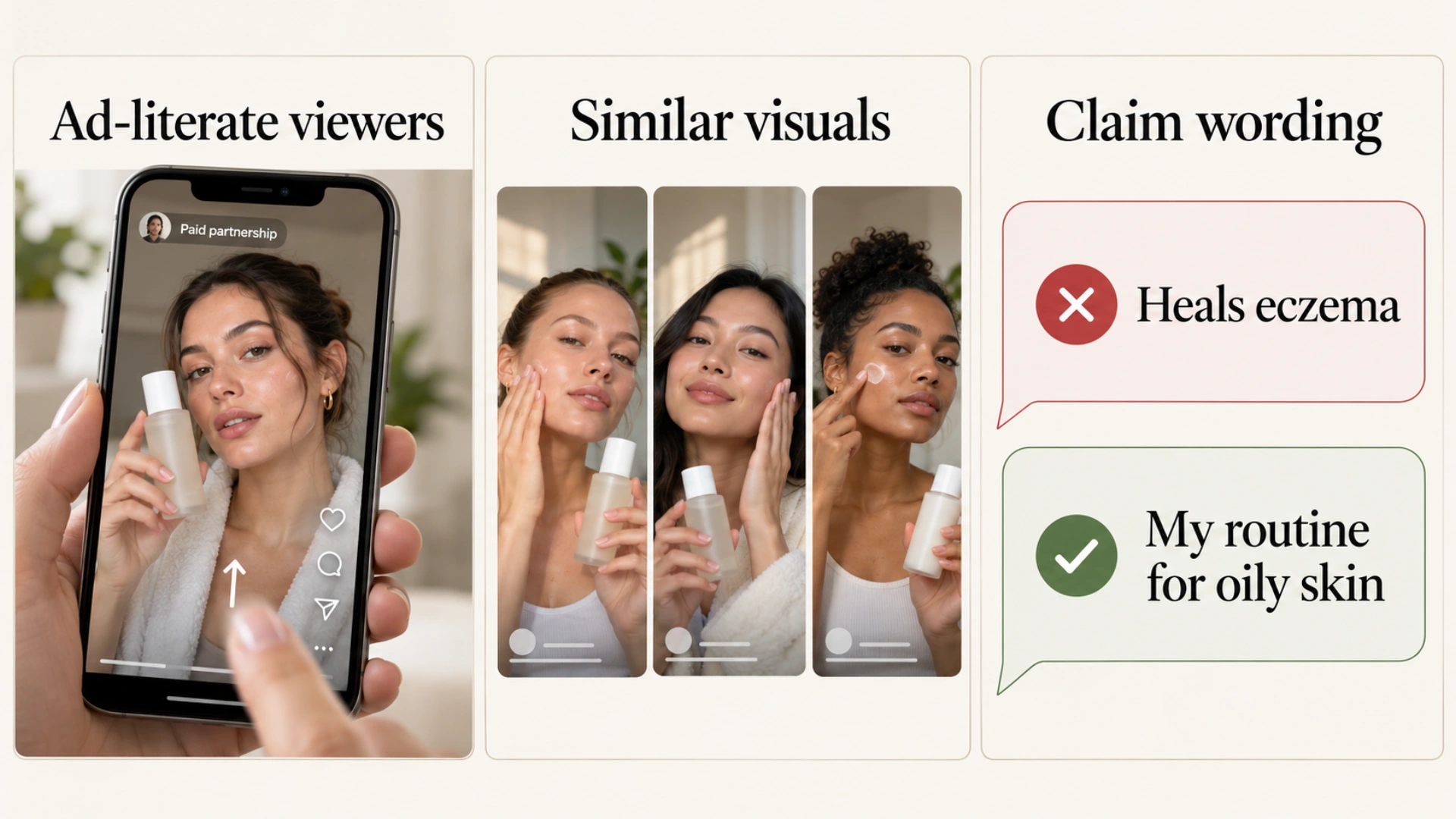
Viewers are ad-literate. Beauty audiences see more sponsored content than almost any other group. Anything that looks like an ad in the first second gets swiped on reflex.
Every frame looks the same. A face, soft lighting, a product in hand. You can't stand out on the visual, so the first sentence does the work.
Claims are regulated. Skincare sits on the line between cosmetics and drugs, and a hook that promises a medical result is a takedown risk as well as a credibility risk.
Creators who share what's working say the same thing: effects and transitions buy a second, but a weak first line still loses the viewer. Plan the hook and the problem first, then the visuals.
Transformation hooks
Still the strongest format, as long as the change is real and the timeframe is stated.
- "Twelve weeks, same lighting, same camera, no filter."
- "This is day one and this is day sixty. I changed three things."
- "I stopped using [common product] for a month. Here's what happened."
- "Left side is the routine I was doing. Right side is what I do now."
- "Same face, same window light, eight weeks apart."
Why they work: a visible before/after needs no trust.
How they fail: different lighting in the two shots. Commenters notice, and the pile-on costs more than the video earns.
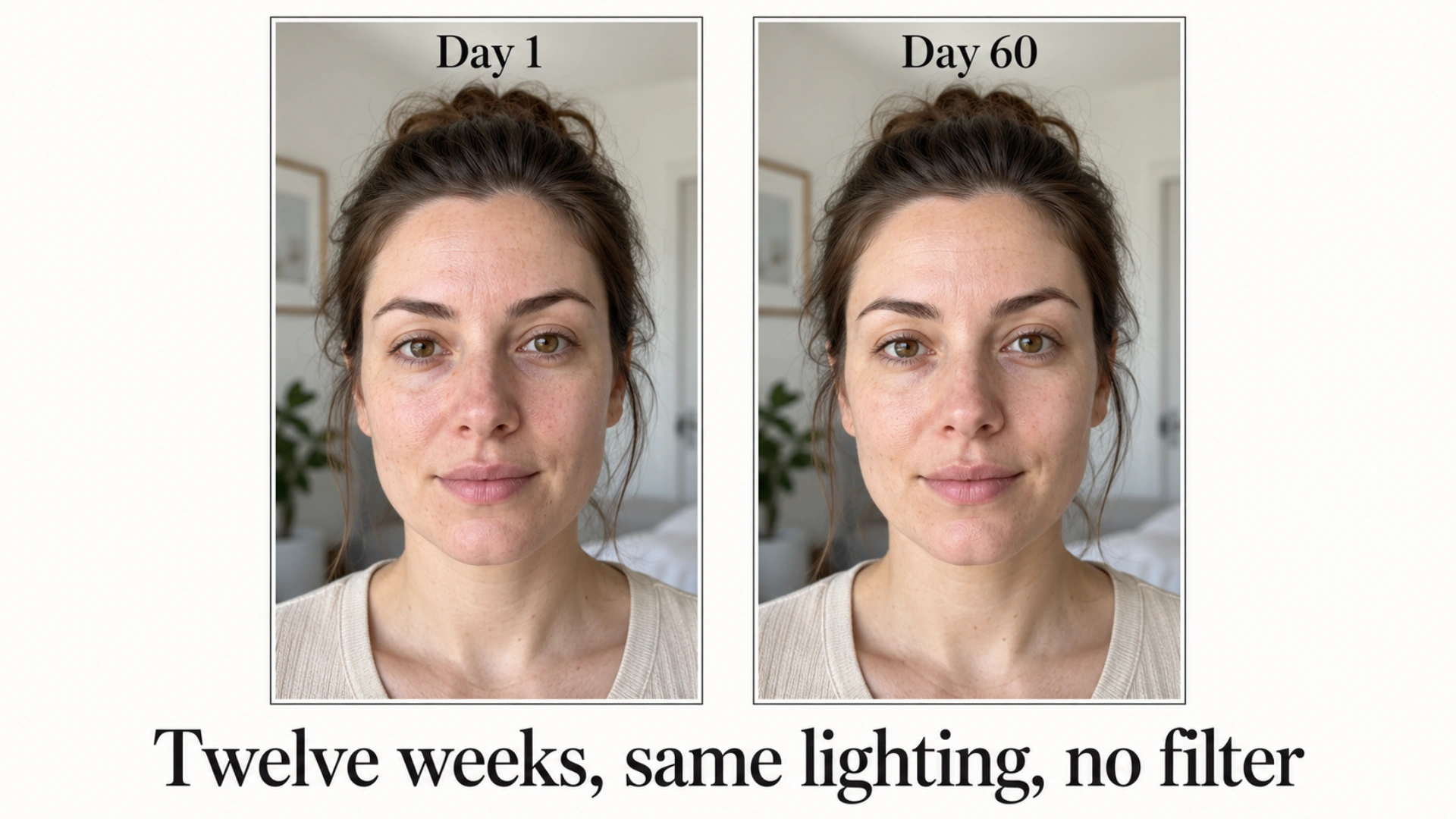
Illustrative lighting and framing example, not a real skincare result.
Myth-busting hooks
The most reliable reach in beauty right now, because the niche is full of bad advice.
- "[Popular ingredient] doesn't do what the label says. Here's what it actually does."
- "You don't need a ten-step routine. You need four of these steps."
- "Stop [common practice]. It's why your [problem] isn't improving."
- "The expensive version and the £9 version have the same active at the same percentage."
- "This trend is going to wreck your skin barrier, and nobody's saying it."
- "Signs your skin barrier is damaged that you're blaming on your products."
Why they work: they position you as the person who knows, and they invite people to argue in the comments, which is engagement.
How they fail: busting a myth nobody believes, or being wrong. Name the ingredient and the percentage; this audience checks.
Routine and process hooks
- "My whole routine is four products and takes ninety seconds."
- "The order you apply these in changes whether they work."
- "Everything I do before a shoot, in real time."
- "The routine for the week your skin is actively angry."
- "One ingredient, explained in under a minute."
Why they work: people save and rewatch them. Saves are one of the strongest signals on both platforms, so reference-style videos (and carousels on Instagram) keep paying off.
Problem-specific hooks
The best converters if you sell a product or a service.
- "If your [specific problem] comes back every winter, this is why."
- "Texture on the forehead isn't the same problem as texture on the chin."
- "This is for anyone whose skin gets worse the more products they add."
- "[Skin type] people: most of the advice you're getting is written for [other type]."
- "If your moisturizer pills under sunscreen, it's usually one of these two things."
Why they work: the right viewer recognizes themselves instantly, and these are the problems people search for.
Esthetician and treatment hooks
- "This is what a [treatment] actually looks like. No music, no cuts."
- "Clients ask me for [treatment]. Most of them need [other thing] first."
- "Three things I can see on your skin that you can't."
- "What I'd never do to my own face."
- "If you're in [city] and you've been putting off [treatment], this is what it involves."
Why they work: professional authority sets you apart from creators, and real treatment footage is naturally watchable. For local businesses, naming the city and pointing to DMs or a booking link turns views into appointments. Consistency matters more than virality: one to three Reels a week, every week.
Beauty hooks for product creators
- "I've gone through [number] of these. This is the only one I repurchased."
- "Dupe test: [premium product] vs [cheaper product], same arm, same light."
- "Texture check before you buy this."
- "Things about [product] the reviews don't tell you."
- "What [amount] actually gets you at [store] right now."
- "If I could only keep three products, it would be these."
Claim rules: the wording that keeps you safe
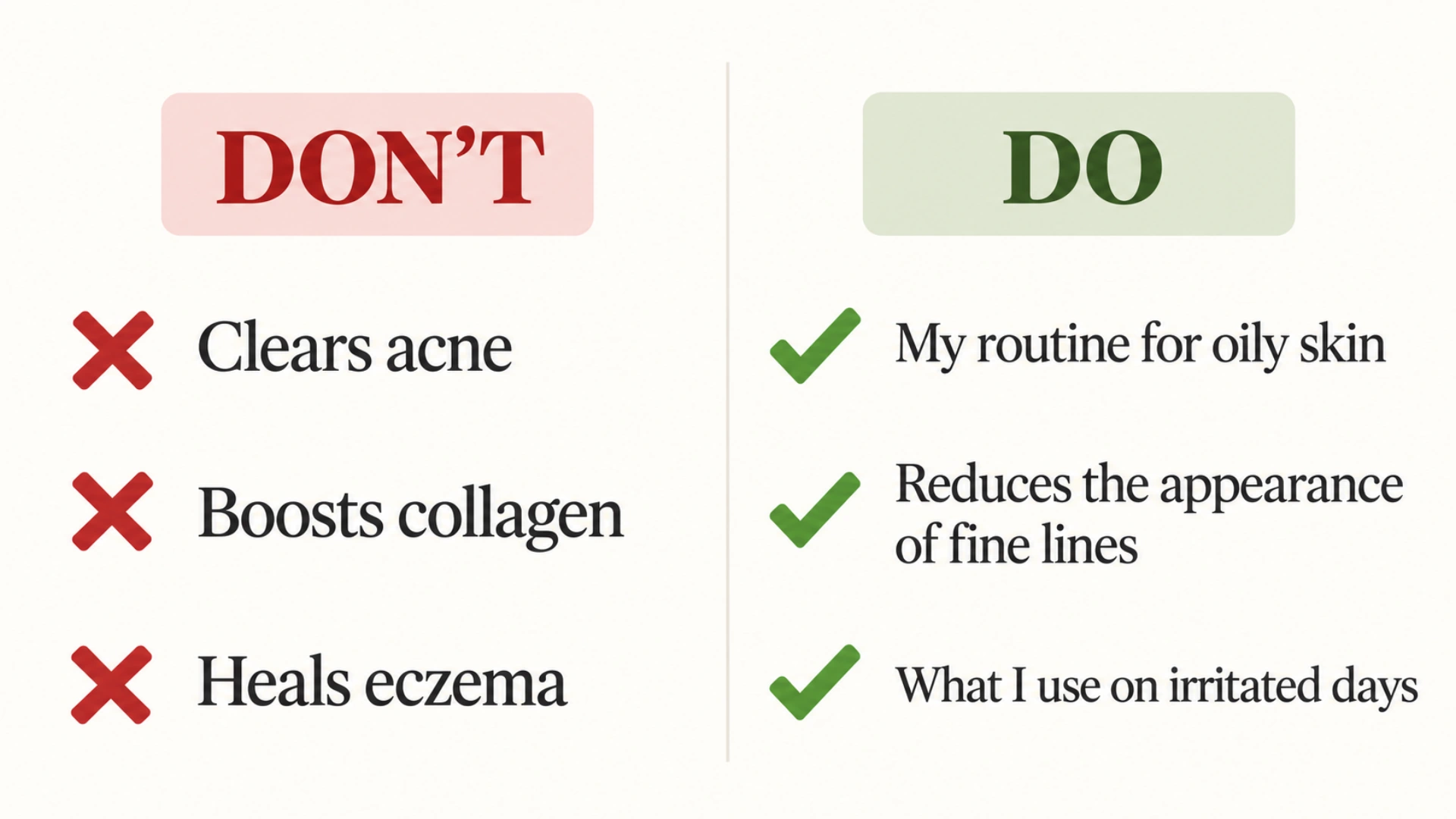
In the US, whether a product counts as a cosmetic or a drug depends on what you claim it does, not just what's in it. The FDA explains that claims to treat or prevent a disease, or to change how the body works, make something a drug. Claims about cleansing or improving appearance are cosmetic.
| Avoid (drug-style claim) | Say instead (cosmetic or personal experience) |
|---|---|
| "Cures acne" / "cleared my acne" | "This is what my skin looked like over twelve weeks while I used it" |
| "Heals eczema" | "This is what I use on the days my skin feels irritated" |
| "Boosts collagen" / "erases wrinkles" | "Reduces the appearance of fine lines" |
| "Reverses aging" | "My routine for skin that looks more even" |
| "Dermatologist-approved" (unless it is) | "What my dermatologist told me to try" (only if true) |
Always disclose. If a product was gifted or the post is paid, say so in the video itself, not only in the caption. The FTC's guidance for influencers asks for a disclosure that's hard to miss, and platforms enforce their own branded-content rules on top.
If you're licensed, say so, and stay inside your scope. Your credential is your biggest asset and the fastest thing to lose.
Matching the hook to the goal
| Goal | Hook type | Notes |
|---|---|---|
| Reach | Myth-busting, transformation | Broadest appeal, most shares |
| Followers | Routine, problem-specific | Gives people a reason to come back |
| Bookings (estheticians) | Treatment, professional authority | Name your city and add a booking CTA |
| Product sales | Problem-specific, transformation | Needs a real before/after |
| Comments | Myth-busting | Invites disagreement |
| Saves | Routine, one-ingredient explainers | Reference content people return to |
What fails in skincare content
Opening on the product. It reads as an ad instantly. Open on the face, the problem, or the claim, and bring the product in around second five.
"This changed my skin." Says nothing. Which product, which problem, how long?
Heavy filters on a skincare claim. They destroy the only evidence you have.
Silent GRWM with trending audio and no hook. The format is saturated; without a first line it looks like thousands of others.
No captions. Beauty gets watched muted a lot: at work, in bed, in public. See best caption fonts for Reels.
Frequently asked questions
What skincare hooks get the most views?
Myth-busting and transformation hooks. Myth-busting has the higher ceiling because it invites argument in the comments, which is a strong engagement signal on both TikTok and Instagram.
Should skincare content go on TikTok or Instagram Reels?
Both, but they do different jobs. TikTok drives discovery and product virality; Instagram converts to follows, DMs, and bookings. Estheticians should prioritize Instagram, product creators TikTok.
How do I make a before-and-after credible?
Same lighting, same camera position, same time of day, no filter, and say the timeframe out loud. If any of those change, viewers assume the difference is the lighting, and they're usually right.
Can I say a product cleared my acne?
"Cleared my acne" is a drug-style claim. "This is what my skin looked like over twelve weeks while I used it" shows the same thing without claiming the product caused it.
How long should a skincare Reel be?
Twenty to 45 seconds for routines and myth-busting, 10 to 20 for transformations. Routine videos can run longer if every step is different.
Batch a week of skincare content in an afternoon. BlitzCut removes the pauses, adds captions muted viewers can read, and keeps the styling identical across every video. Available on iPhone, iPad, Mac, and Android.
Related: Best TikTok Hooks 2026 · Best Instagram Reels Hooks · Best Caption Fonts for Reels · Brand Deals for Small Creators · Content Pillars for a Creator Brand
Editing a talking-head video?
BlitzCut is available on Android, iPhone, iPad, and Mac. It is designed for recorded UGC-style videos, founder-led ads, tutorials, and testimonials and other talking-head content.
Try it for freeRelated Articles
Keep Reading

Best TikTok Caption Fonts: What Top Creators Use (2026)
The best TikTok caption fonts are Montserrat Bold, Poppins, and Bebas Neue. See 9 fonts top creators use, with exact sizes, colors, and animations.

Best Auto Caption App for iPhone (2026): 8 Apps Compared
The best auto caption app for iPhone: BlitzCut, CapCut, Captions, Edits, InShot, VN, KineMaster, and Premiere compared on caption styles, editing, SRT export, and price.

Best CapCut Alternatives (2026): 10 Apps Like CapCut for iPhone, Android and PC
The best CapCut alternatives for iPhone, Android, Mac, and PC: free and paid apps like CapCut, compared on silence removal, captions, templates, watermarks, and price.