
YouTube Shorts Algorithm 2026: What Actually Drives Growth
YouTube Shorts reached 200B daily views in 2026. Algorithm fully decoupled from long-form — the signals that drive distribution and how editing moves them.


YouTube Shorts crossed 200 billion daily views in 2026, up from 70 billion in early 2024. The algorithm driving that distribution is no longer a simplified version of the long-form YouTube recommendation engine — it was fully decoupled in late 2025 and now operates on its own set of signals. The most important one is swipe-away rate. Everything else — loop rate, shares, comments — matters, but the algorithm's first filter is whether viewers keep watching after the first two seconds.
This is the practical guide for creators who want to understand what the Shorts algorithm actually rewards and how to edit and structure content to perform against those signals.
How the Shorts Algorithm Is Different in 2026
Three changes in the past 18 months fundamentally altered how Shorts performs:
1. Full decoupling from long-form (late 2025) Shorts performance no longer affects your long-form channel recommendations, and vice versa. A Short that underperforms doesn't penalize your regular videos. A viral Short doesn't guarantee your long-form audience grows. They're treated as separate content types with separate ranking systems.
2. Satisfaction signals now outweigh raw watch time YouTube's historical algorithm prioritized watch time above almost everything else. The Shorts algorithm shifted this: post-watch behavior and viewer satisfaction surveys now carry more weight than whether someone watched 100% of your Short. A Short that someone watches fully but immediately dislikes performs worse than one that gets skipped but earns a share.
3. 200B daily views creates a more competitive feed More daily views means more creators competing for the same feed slots. The algorithm has more data to work with and can be more selective. Shorts that would have gotten moderate distribution in 2024 now need stronger signals to reach the same audience.
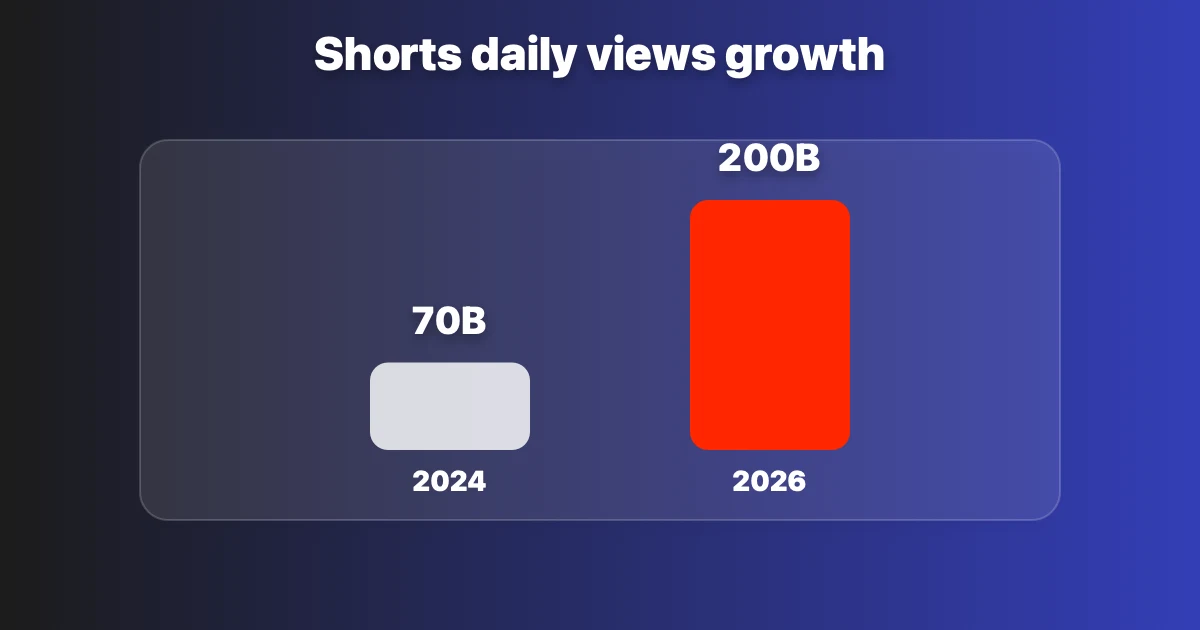
Shorts daily view count nearly tripled between early 2024 and 2026. The algorithm has become more competitive and more sophisticated.
The Core Ranking Signals
1. Swipe-Away Rate (Most Important)
When a viewer swipes past your Short, YouTube reads that as a negative signal. The algorithm tracks swipe-away rate continuously — if too many people swipe before the 2-second mark, distribution slows or stops entirely.
The first 2 seconds are the algorithm's primary filter. Research shows that if a viewer doesn't swipe away in the first 2 seconds, the probability of watching to completion increases by roughly 60%.
What affects swipe-away rate:
- Visual hook in the first frame (something unexpected, visually interesting, or text that poses a question)
- Spoken hook in the first sentence (a claim, a promise, or a question that demands resolution)
- No slow intros, no "hey guys," no context-setting before value delivery
2. Loop Rate
Shorts loop automatically. The algorithm tracks how often viewers watch your Short more than once. A Short with a 150% loop rate (most viewers watch it 1.5 times) signals strong content that earns extended distribution.
What drives looping:
- Content that rewards re-watching (a reveal, a punchline, a fact that needs to be verified)
- A slightly ambiguous ending that makes viewers replay to confirm what they saw
- Short duration (under 30 seconds) — loops naturally at a higher rate than 59-second Shorts
3. Shares (Especially to Non-Followers)
A share to someone who doesn't follow you is one of the strongest signals the algorithm uses. It signals genuine utility — the viewer found it valuable enough to send to a specific person. This type of share carries significantly more weight than saves or likes.
What drives shares:
- Surprising or counterintuitive information
- Content that's directly relatable to a specific situation people want to share with others
- Humor that works on a specific in-group (niche humor gets shared within that niche)
4. Comments
Comments indicate engagement depth — the viewer stopped the viewing session to type, which is a high-friction action. The algorithm rewards comment volume, but comment quality signals matter too: responses from the creator to comments are tracked and improve content longevity.
5. Likes Per Reach (Not Raw Likes)
The algorithm looks at your like rate (likes ÷ impressions), not your raw like count. A Short with 500 likes from 5,000 impressions (10% like rate) outperforms one with 2,000 likes from 200,000 impressions (1% like rate) in algorithmic signals, even though the second has more total likes.
What This Means for Editing
The algorithm doesn't directly read your editing choices. It measures viewer behavior — and your editing choices drive viewer behavior.
Hook in Frame 1, Not Frame 3
Your first frame should contain something that makes the viewer stop scrolling. Static, low-energy first frames lose viewers before they process any context. Options:
- Text overlay on screen that poses a direct question or makes a bold claim
- A visually unusual or striking shot
- Mid-action footage — you're already doing or showing something, not starting cold
Cut Fast, Stay Tight
Long pauses and silence between thoughts increase swipe-away probability. Every second of dead air is a moment when the viewer's finger moves to swipe.
Silence removal — cutting all pauses longer than 0.3–0.5 seconds — is one of the highest-leverage editing actions for Shorts specifically. It's the difference between a 60-second Short that feels tight and one that feels padded.
BlitzCut runs silence removal on-device immediately after import, making it one of the fastest tools for this specific step on Mac and iPhone. Under $6/month billed annually. DaVinci Resolve and Descript also handle silence removal, at higher price points.
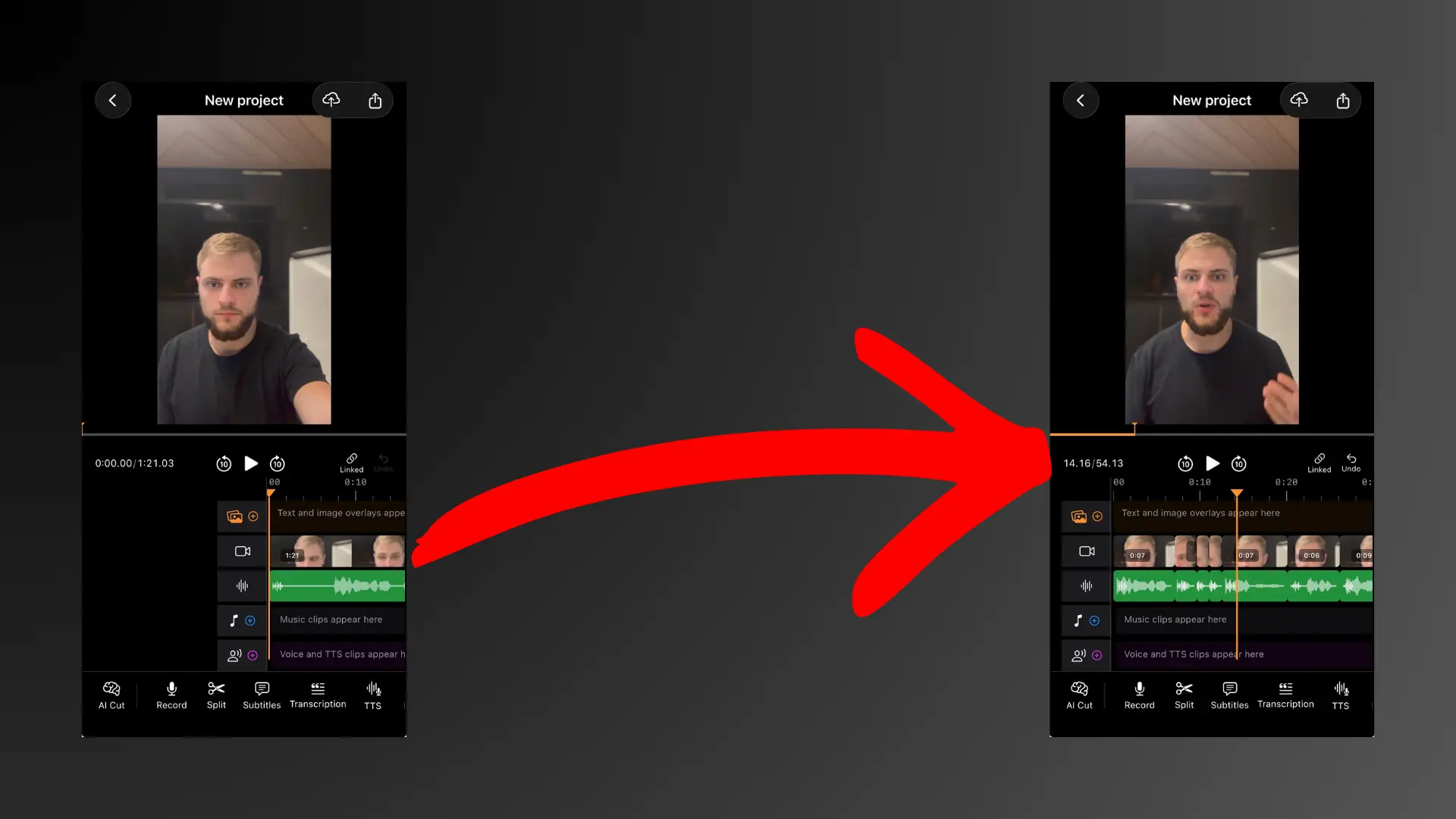
Before and after silence removal. The bottom timeline has dead air cut. Pacing is tighter, swipe-away rate drops, loop rate increases.
Use Animated Captions
85% of YouTube Shorts are watched without sound in at least part of their viewing session. Captions aren't optional — they're how most of your audience follows along.
Beyond accessibility, animated word-by-word captions (karaoke style) hold viewer attention by giving them something to track visually. Each word appearing in sequence creates a micro-engagement loop that reduces swipe-away probability.
Keep Duration Strategic
Shorter Shorts loop at higher rates. If your content can be delivered in 30 seconds, don't pad it to 55 seconds. The loop rate signal from a 25-second Short with 200% loop rate outperforms a 58-second Short with 100% completion rate in most algorithm scenarios.
That said: if your content genuinely requires 55–60 seconds to land, don't artificially compress it. Forced compression creates rushed pacing that hurts retention more than it helps loop rate.
No Watermarks, No Reposts
YouTube's algorithm in 2026 detects recycled content — particularly videos with visible watermarks from TikTok, Instagram, or other platforms. Reposted content receives significantly reduced distribution. Always export clean (no watermark) and post natively.
Content Strategy for Shorts Growth
Post Natively, Not Repurposed
Shorts filmed and edited specifically for the Shorts feed outperform repurposed long-form clips. This doesn't mean you can't convert long-form to Shorts — but the best-performing repurposed clips are edited for the format, not simply trimmed and exported vertically.
A 10-minute YouTube video clipped to a 45-second Short needs:
- A standalone hook that doesn't require context from the full video
- Captions (since viewers aren't expecting audio from a "preview" clip)
- An ending that delivers complete value, not "watch the full video for more"
Frequency: 3–5 Shorts Per Week Minimum
The algorithm needs consistent signals to build a recommendation profile for your channel. One Short per week gives the system too little data. Three to five per week provides enough signal for the algorithm to identify your audience and expand reach.
This is where batch recording (filming 6–10 Shorts in one session, scheduling across the week) makes daily-level consistency achievable without daily production effort.
Trending Audio
YouTube Shorts has a trending audio section. Using a trending sound adds a small algorithmic boost and places your Short in the discovery feed for that audio. This is a secondary signal — good content with a trending sound outperforms weak content with one, but trending audio doesn't compensate for low hook quality.
Niche Consistency
The algorithm builds a model of your audience over time. Highly varied content across different niches slows this process. A creator who posts consistently within a niche (cooking, coding, fitness, finance) gets faster audience-building than one who switches topics frequently. The algorithm can't reliably identify who to show your content to if each Short targets a different interest group.
Metrics to Track (In Order of Importance)
| Metric | Target | Why |
|---|---|---|
| Swipe-away rate (first 2 sec) | Under 40% | Primary filter signal |
| Average view duration | Above 70% | Indicates content quality |
| Loop rate | Above 100% | Strong secondary signal |
| Share rate | Above 1% | High-weight positive signal |
| Like rate | Above 3% | Engagement breadth signal |
You can find these metrics in YouTube Studio → Analytics → Shorts-specific views. The swipe-away rate is labeled "Impressions click-through rate" in some dashboard versions — check "viewer actions" for the specific swipe data.
Frequently Asked Questions
Does YouTube Shorts affect my main channel's algorithm?
Not in 2026. YouTube fully decoupled Shorts and long-form recommendation engines in late 2025. Shorts underperformance doesn't penalize your main channel, and Shorts viral performance doesn't guarantee long-form growth. Subscribers gained through Shorts tend to be Shorts-only viewers who may not convert to long-form watchers.
How long should YouTube Shorts be in 2026?
15–45 seconds performs best for most niches. Under 15 seconds can work for punchy content but limits depth. 55–60 seconds is viable if the content genuinely warrants it, but loop rate (a key signal) decreases with length. Don't pad to fill time — cut to the shortest version that delivers complete value.
Does posting frequency matter for Shorts?
Yes. 3–5 Shorts per week is the minimum for meaningful algorithmic growth. Below that, the system has too little data to build a reliable recommendation profile. Above 5 per week, there are diminishing returns on the consistency benefit, though high-frequency posting (daily or more) still helps raw reach.
Why are my Shorts getting 0 views?
First Shorts from a new channel often get no algorithmic distribution. YouTube needs to observe several pieces of content before building a recommendation profile. Post 10–15 Shorts before drawing conclusions about performance. Ensure each Short has a strong first 2 seconds — the algorithm's first filter determines whether anyone beyond your initial audience sees each piece.
Do hashtags help Shorts discovery?
Marginally. 1–3 relevant hashtags (including #Shorts) provide small discoverability signals in the search tab. They don't meaningfully affect the Shorts feed algorithm. Hook quality, swipe-away rate, and niche consistency are orders of magnitude more important.
Related: How to Grow YouTube Shorts · How to Add Captions to YouTube Shorts · YouTube Shorts Editing Tips · Safe Zones for YouTube Shorts, Reels, and TikTok
Last Updated: May 22, 2026 Category: Platform Strategy
Post every day without spending hours editing
BlitzCut is a native app for iPhone, iPad, and Mac. Get from raw footage to TikTok-ready in under 2 minutes, so editing is never the reason you didn't post.
Try it for freeRelated Articles
Keep Reading

Best Video Editing App for E-Commerce Sellers (2026)
Find the best video editing app for e-commerce sellers: compare 5 tools for talking-head UGC, founder-led ads, product demos, and Shopify videos.

Best Adobe Premiere Rush Alternatives (2026): Where to Go Before It Shuts Down
Premiere Rush support ends September 30, 2026. The best alternatives for Mac, iPhone and Android — including Adobe's own replacement — and how to migrate.

Best AI Clipping Tools, Rated by What Users Actually Say (2026)
Best AI clipping tools compared on independent user reviews, billing complaints, and pricing: Vizard, OpusClip, Klap, Quso, and BlitzReels. Plus OpusClip alternatives.