
Animated Captions vs Static Captions: Which Gets More Views in 2026
Animated vs static captions for short-form video: what the data shows on watch time and completion rate, and when static captions are still the right call.


The claim circulates widely: animated captions get more views than static subtitles. Word-by-word text synced to speech outperforms a static subtitle block that stays on screen for three seconds.
The claim is probably true. But the evidence behind it is murkier than most caption tool vendors will tell you — a mix of real behavioral research, solid observational data from large datasets, and vendor statistics that cannot be independently verified. Understanding which is which matters if you are going to make production decisions based on it.
This guide covers what animated versus static captions actually are, what the data says with appropriate confidence levels, the cognitive science behind why animation is theorized to outperform static, and the cases where static captions are still the right choice.
Definitions: What "Animated" and "Static" Mean
Static captions (closed captions / SRT-style subtitles): A block of text appears on screen for the duration of a sentence or phrase, then disappears and is replaced by the next block. The text does not move, highlight, or change within each block. This is the traditional subtitle format used by broadcasters, YouTube's auto-generated captions, and most accessibility-focused publishing.
Animated captions: Text that changes state in sync with speech — most commonly word-by-word (each word appears or highlights as it is spoken), phrase-by-phrase pop-in, or with motion effects (scale, bounce, fade) on word entry. The dominant animated format in 2026 is word-by-word karaoke, where a highlight color moves across words as they are spoken.
The distinction that matters: animated captions are timed to speech at the word level. Static captions are timed to phrases or sentences.
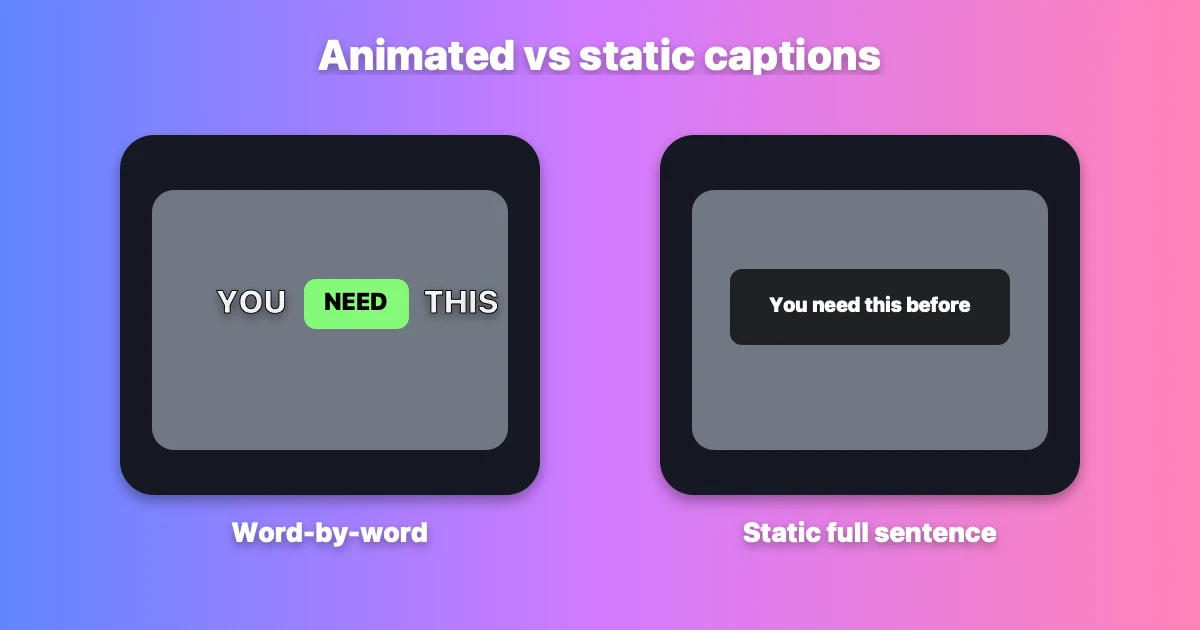
Word-by-word karaoke (left) vs static sentence block (right). The karaoke style creates a moving focal point that guides the viewer's eye in sync with speech — no re-sync work between blocks.
The Data: What We Know with Confidence
What is well-established
Captions of any kind significantly increase watch time and completion rate.
The most methodologically credible study is the Verizon Media / Publicis Media study (2019, n=5,616 US adults, ages 18–54): 80% of respondents said they were more likely to watch a video to completion when captions were available. 50% said they needed captions because they watch video in sound-sensitive environments.
This study covers captions generally — not animated vs. static specifically — but it establishes the baseline: captions are a watch-time lever, not a nice-to-have.
70–85% of short-form social video is watched with sound off or low.
The often-cited "85% of Facebook videos watched on mute" figure originates from publisher self-reporting on Facebook feed video in 2016 (Digiday) and has been applied far beyond its original scope. A more defensible 2026 estimate, drawing on multiple sources: 70–85% of short-form social video viewing happens without active sound, with the exact percentage varying by context (commuting, public spaces drive it higher; home viewing drives it lower).
The Instagram head stated approximately 50% of Reels specifically are watched without sound. TikTok's own newsroom confirms muted viewing is dominant for in-feed content.
80.2% of viral-tier TikTok clips use burned-in captions.
OpusClip analyzed 13.5 million clips in Q1 2026. Among clips that achieved viral distribution: 80.2% used burned-in (hardcoded) captions. 78.6% of those clips had animated captions (synced, dynamic presentation). This is the largest publicly available dataset on this question. Caveat: OpusClip sells animated caption software, so this is vendor data, not a peer-reviewed study.
What is plausible but not independently verified
Animated captions hold viewers 15–20% longer than static captions.
This figure circulates across multiple caption tool vendor sites (Submagic, Braiv, OpusClip, Captions.ai). The original methodology is not published. It is consistent with the directional finding from the OpusClip dataset and with the cognitive science below, but it should be treated as a directional estimate rather than a precise measurement.
Word-by-word captions increase completion rate by approximately 15% vs. full-sentence captions on educational content.
Same caveat: vendor data, directionally consistent, methodology not published.
The Cognitive Science: Why Animation Is Theorized to Work
This section has the strongest academic grounding, though none of it directly tests TikTok caption formats.
Dual Coding Theory (Allan Paivio)
Information processed simultaneously through the verbal channel (words) and the visual/imagery channel (moving visual cues) creates stronger encoding than either channel alone. A 2019 MDPI paper directly applied dual coding theory to film subtitles, finding captions reinforced both verbal and visual encoding for language learning.
For animated captions: the moving highlight or pop-in animation engages the visual processing channel simultaneously with the verbal processing of the words being read. This is not available with static subtitles where the visual channel sees a static block.
Cognitive Load Theory
Working memory in 15–60 second video content is bounded — viewers are simultaneously processing visual information, tracking narrative structure, and attempting to extract meaning. A 2024 MDPI study on short-form video ads ("One Face, Many Roles") explicitly applies cognitive load theory to TikTok-style content, noting that any reduction in processing friction improves content retention.
Animated captions reduce the cognitive work required for muted-view comprehension. Instead of the viewer having to parse a sentence-block of text, match it to the speaker's position in speech, and re-sync after a block change, the word-by-word animation provides a real-time guide that removes this re-sync work.
The Attention-Guiding Mechanism
Word-by-word highlighting creates a moving focal point that guides saccadic eye movement — the micro-movements of the eye as it scans a visual field. The eye naturally follows moving elements. A word that appears or highlights in sequence with speech captures this movement and directs attention to the caption at precisely the moment the word is being spoken.
The closest academic evidence: a 2023 arxiv study ("Useful but Distracting: Keyword Highlights and Time-Synchronization in Captions") found that time-synchronized word highlighting improved comprehension in language learning contexts. It also noted potential distraction trade-offs in high-density content — a nuance relevant to the static-sometimes-wins cases discussed below.
The Algorithm Signal Hypothesis
Watch time and completion rate are the primary distribution signals on TikTok, Instagram Reels, and YouTube Shorts. Adam Mosseri (Instagram head) has confirmed watch time, likes-per-reach, and DM shares as the top Reels ranking factors.
Captions improve watch time by enabling muted viewing. Animated captions are theorized to improve watch time beyond static captions by reducing cognitive friction and guiding attention. The algorithm does not score caption style directly — it scores the behavioral output (completion rate, re-watches, shares) that caption style affects.
One vendor estimate (Braiv): a 5% lift in average completion rate roughly doubles algorithm distribution allocation. If animated captions produce a 10–15% watch time improvement over static, the compound effect on distribution is significant.
When Static Captions Are the Right Choice
Static captions are not uniformly inferior. There are contexts where they outperform animated formats:
Dense informational content. When the content is complex — legal explanations, detailed product specifications, multi-step technical instructions — viewers need to read the full sentence before it disappears. Word-by-word animation on dense content forces the viewer to track quickly without allowing them to re-read. Static blocks that stay on screen long enough to read completely are more effective here.
Formal and institutional content. News organizations, B2B LinkedIn content, educational institutions, and accessibility-focused publishers use static captions because they meet closed-caption compliance standards. Pre-burned animated captions do not allow viewers to toggle them off, which fails accessibility compliance requirements.
Slow, contemplative content. For meditative, ambient, or slow-burn storytelling content, word-by-word animation introduces a visual rhythm that may conflict with the pacing. Static captions can be less intrusive in content where the goal is immersion rather than engagement.
Multi-language content. Static SRT files allow platform translation layers (Instagram's AI translation, YouTube's auto-translate) to operate on the subtitle track. Animated pre-burned captions cannot be translated because the text is baked into the video pixels.
The Production Workflow Difference
A practical consideration that affects which format creators actually use:
Static captions: Can be generated as SRT files by any transcription tool (MacWhisper, Whisper CLI, Otter, Descript) and uploaded to platforms as a separate track. Production complexity is low. The platform displays them according to its own styling.
Animated captions: Must be burned into the video file. Production requires a tool that generates word-by-word animation with accurate timing (CapCut, Submagic, BlitzCut, Captions.ai, Descript). The output is a rendered video with captions embedded — one file, one style, no toggle.
The burned-in approach means animated captions are visible to every viewer on every platform immediately on play, including muted scrollers. Static SRT captions depend on the viewer's caption settings — on TikTok, platform auto-captions are available but not always on by default.
For creators whose primary goal is reach: pre-burned animated captions are the standard recommendation precisely because they do not depend on viewer settings.
Head-to-Head Summary
| Factor | Animated captions | Static captions |
|---|---|---|
| Watch time for talking-head content | Higher (15–20% vendor estimates) | Lower |
| Watch time for dense informational content | May reduce (forced pacing) | Higher |
| Muted-view comprehension | Higher (word-by-word guidance) | Lower |
| Accessibility compliance | No (cannot be toggled off) | Yes (meets WCAG toggle requirement) |
| Cross-platform translation | No (text baked into pixels) | Yes (SRT track translatable) |
| Production complexity | Medium–high (requires timing-aware tool) | Low (any transcription tool exports SRT) |
| Viral TikTok content usage | 78.6% use animated | 21.4% use static |
| Formal/institutional content | Uncommon | Standard |
| Recommended for social short-form | Yes | Only for compliance or dense content |
How to Generate Animated Captions
BlitzCut (Mac): Transcript-based editing → one-tap karaoke caption generation. Word-by-word timing derived from the transcript. Available in standard, bold center, and karaoke styles.
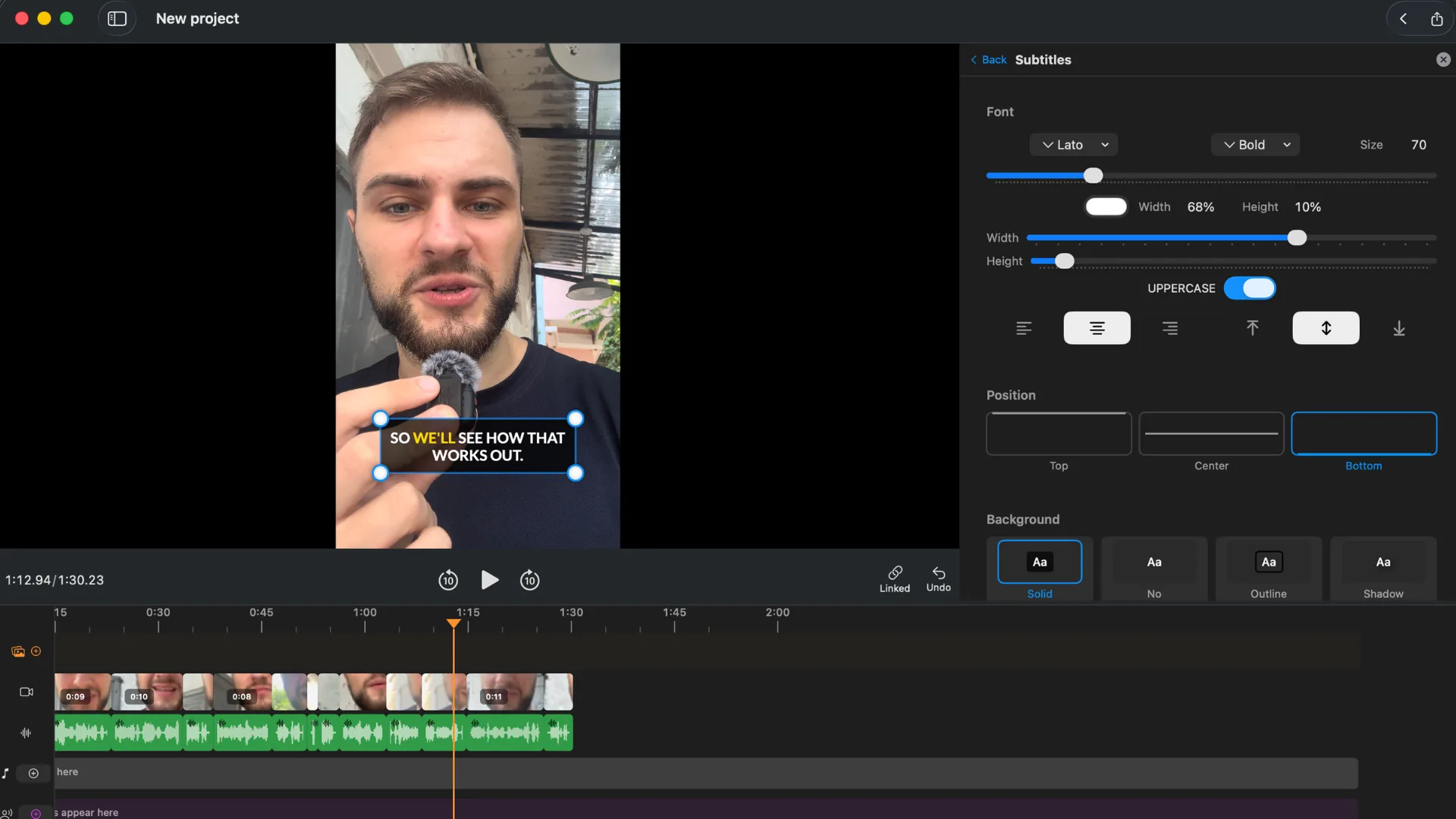
BlitzCut's karaoke output. Each word is timed from the transcript — corrections made to the text carry through to caption timing automatically, with no separate sync step.
CapCut: AI auto-captions with animated style presets including the Hormozi template. Available on iOS, Android, and desktop. Free tier adds watermark.
Submagic: Specialist caption tool with 100+ animated presets including named Hormozi variants. High accuracy (claimed 98.9%). Web-based.
Captions.ai: iOS-first tool with animated captions, filler word removal, and eye contact correction for talking-head content.
Frequently Asked Questions
Do animated captions really get more views than static captions? The evidence is directionally consistent: viral TikTok content uses animated captions at a higher rate (78.6% vs. ~21%), and cognitive science supports the attention-guiding mechanism. Precise percentages from vendor claims (15–20% watch time lift) are not independently verified, but the direction of the effect is well-supported.
What is the difference between animated and karaoke captions? Karaoke captions are a type of animated caption — specifically, word-by-word highlighting where a color moves across words as they are spoken. All karaoke captions are animated; not all animated captions are karaoke-style (some use pop-in, bounce, or scale effects without a moving highlight).
Are static SRT subtitles ever better? Yes — for dense informational content where viewers need to read full sentences, for content requiring accessibility compliance (toggleable captions), and for multi-language content that needs platform translation layers to operate on the subtitle track.
Do animated captions help with TikTok's algorithm? Not directly — the algorithm scores behavior (watch time, completion rate, shares), not caption style. Animated captions affect the behavioral outputs the algorithm measures. The effect is indirect but real.
Can I use both animated captions and platform auto-captions? You can burn animated captions into the video and also upload an SRT file as a closed caption track. This gives you both: animated captions visible to all viewers, plus a toggleable SRT for accessibility. Most creators who use pre-burned animated captions skip the SRT upload for social short-form.
Related: Word-by-Word Captions vs Full-Sentence Captions · TikTok Caption Trends 2026 · Best Caption Style for TikTok
Post every day without spending hours editing
BlitzCut is a native app for iPhone, iPad, and Mac. Get from raw footage to TikTok-ready in under 2 minutes, so editing is never the reason you didn't post.
Try it for freeRelated Articles
Keep Reading

Best Video Editing App for E-Commerce Sellers (2026)
Find the best video editing app for e-commerce sellers: compare 5 tools for talking-head UGC, founder-led ads, product demos, and Shopify videos.

Best Adobe Premiere Rush Alternatives (2026): Where to Go Before It Shuts Down
Premiere Rush support ends September 30, 2026. The best alternatives for Mac, iPhone and Android — including Adobe's own replacement — and how to migrate.

Best AI Clipping Tools, Rated by What Users Actually Say (2026)
Best AI clipping tools compared on independent user reviews, billing complaints, and pricing: Vizard, OpusClip, Klap, Quso, and BlitzReels. Plus OpusClip alternatives.